

Are Graphic Tees Still in Style? Yes, Here's How to Wear Them
Table of Contents
- Are Graphic Tees Still in Style in 2026?
- How Graphic Tee Trends Have Changed
- How to Style Graphic Tees Without Looking Sloppy
- Graphic Tee Outfit Ideas for Real Life
- Choosing the Right Fit and Fabric Quality
- Minimalist vs. Bold Prints: Finding Your Visual Balance
- Caring for Graphic Tees So the Print Lasts
- Conclusion
- Frequently Asked Questions
Last Updated: September 20, 2026
Are Graphic Tees Still in Style in 2026?
Yes, graphic tees are still in style in 2026, and the category has quietly grown up. The graphic tee is now a wardrobe staple people use to signal humor, values, and personality without saying a word. This guide from Clothed in Kindness Apparel covers how to wear one well, what to look for in fit and fabric, and how to keep the print sharp.
How Graphic Tee Trends Have Changed
The biggest shift is that graphic tees stopped being disposable novelties and became part of a considered wardrobe. Where early printed tees leaned on loud slogans and oversized logos, the current direction favors vintage-inspired washes, muted palettes, and designs that feel personal rather than promotional.
How to Style Graphic Tees Without Looking Sloppy
The difference between a graphic tee that looks sharp and one that looks like laundry day comes down to fit, contrast, and what you pair it with.
Then build contrast. A casual tee looks more deliberate when it sits next to something slightly more structured:
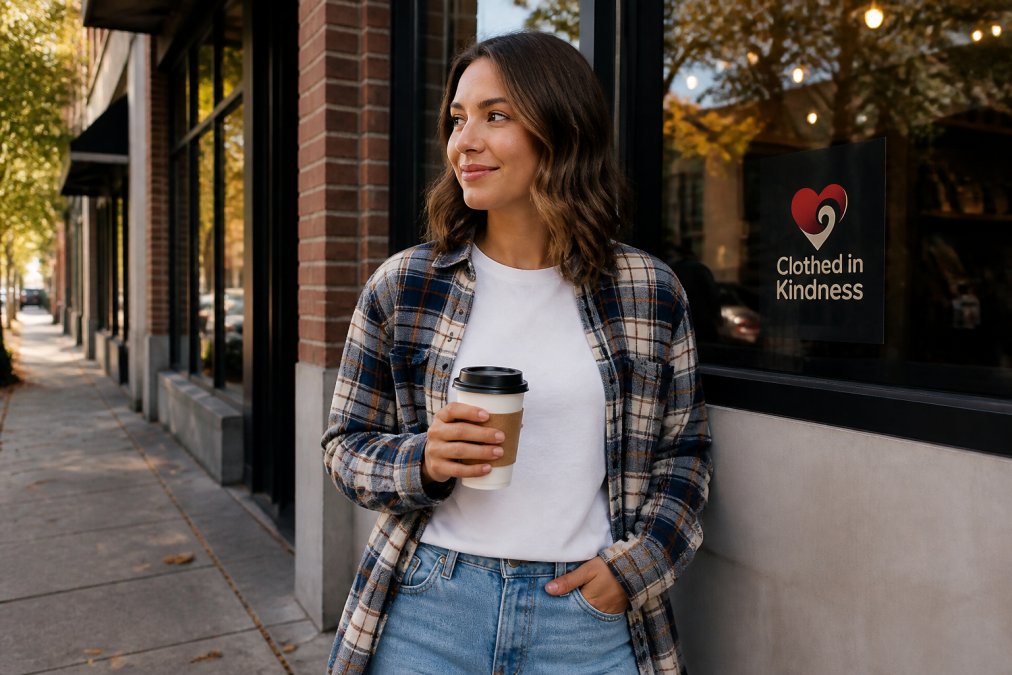
- Layer an open button-down or flannel over a graphic tee
- Tuck the front hem into higher-waisted trousers or jeans
- Add a blazer or overshirt for a smart-casual look
- Pair with clean sneakers or boots instead of worn-out shoes
- Keep accessories minimal so the print stays the focal point
Graphic Tee Outfit Ideas for Real Life
A graphic tee works for more situations than most people assume. The trick is matching the energy of the print to the setting, and the cut of the tee to your actual proportions.
Start with proportion, not the outfit
Where a print sits on your torso changes how your whole body reads. It's the most useful thing to understand before you buy another tee:
- Print across the chest or upper torso draws the eye upward and adds visual width to the shoulders. Good if you want a broader top line; less good if you're already broad-shouldered and want balance.
- Print centered at the midsection pulls attention to the waist. On a longer torso it can break up the line nicely. On a shorter torso it can make the shirt look like it's sitting in the wrong place.
- Small left-chest or pocket-area print reads as the most understated option and is the easiest to wear under a layer, because the graphic stays visible even when a jacket is open.
- Large back print is a different garment entirely in terms of styling. It's invisible from the front, which means the front of the outfit has to carry itself. Pair a back-print tee with a plain front and let the back be the surprise.
Casual weekend
A relaxed-fit tee with straight-leg jeans and a denim jacket is the default for a reason, it works on almost every body type. Shorter frames do better with a tee closer to hip length; taller frames balance better with an oversized tee and a longer hem.
Smart-casual and office-adjacent
This is where most graphic tee advice gives up, and it's the situation people actually need help with. A graphic tee can work in a business-casual environment, but the margin is narrower than on the weekend.
Night out
An oversized tee half-tucked into dark jeans with a leather jacket reads confident without effort, and it's forgiving across body types because the jacket supplies structure the tee doesn't have to. Broader through the shoulders? Skip oversized and go relaxed, the jacket already adds width.
| Setting | Pair It With | Keep It Casual By |
|---|---|---|
| Weekend errands | Straight-leg jeans, denim jacket | Leaving the hem loose |
| Smart-casual office | Tailored trousers, structured overshirt | Tucking the front hem |
| Night out | Dark jeans, leather jacket | Half-tucking the tee |
| Layered fall look | Open flannel, boots | Rolling the overshirt sleeves |
| Back-print tee day | Plain front, simple bottoms | Letting the back do the work |
Choosing the Right Fit and Fabric Quality
Fit and fabric decide whether a graphic tee survives more than a season. Two shirts can look identical on a hanger and behave completely differently after a month of wear, and the difference usually comes down to fabric weight, dye method, and seam finishing.
What fabric weight actually does
Fabric weight is measured in ounces per square yard, and it predicts how a tee will behave more reliably than almost anything else on the label.
- Lightweight (roughly 4-4.5 oz) feels cool and drapes loosely. It's comfortable in heat, but it stretches at the neckline, goes slightly transparent in lighter colors, and gives a screen print less surface to hold onto.
- Midweight (roughly 5-6 oz) is the sweet spot most people land on. It holds its shape through repeated washing, supports a print without the graphic sinking into the fabric, and still breathes.
- Heavyweight (roughly 6.5 oz and up) has real structure and a substantial hand-feel. It resists stretching and holds a print beautifully, but it can feel warm in summer and takes longer to dry.
Why garment-dyed cotton ages differently
Garment dyeing means the finished shirt is dyed after it's sewn, rather than the fabric being dyed before cutting. The dye penetrates the whole garment instead of sitting on the surface, which is why garment-dyed tees have a softer, slightly uneven color and a broken-in feel from the first wear.
Anti- Social Butterfly — Tee CC 1717 →
How to evaluate a tee before you commit
A few things worth checking, whether you're holding the shirt in person or reading a product page:
- Fabric weight and fiber content. Heavier ring-spun cotton tends to hold structure longer than lighter or blended fabric. Ring-spun cotton is spun and twisted more tightly than standard cotton, which produces a smoother, stronger yarn.
- Neck construction. A twill-taped neck, a strip of fabric running along the inside back of the collar, resists the stretching that turns a crew neck into a scoop neck over time. A ribbed collar with a narrow band stretches faster than a wider one.
- Seam finishing. Double-needle hems use two parallel rows of stitching, which distributes stress across the seam and survives repeated washing better than a single row.
- Shoulder seams. They should land near the edge of your shoulder, not down your arm. A seam that sits too low drags the whole shirt out of shape.
- Fit through the chest. A relaxed fit that skims without pulling keeps the print from distorting across the chest. If the graphic stretches when you move, the shirt is too small.
Sizing, honestly
Fit varies by garment, and a relaxed cut in one style won't match a relaxed cut in another. Clothed in Kindness Apparel produces its apparel to order and publishes sizing details on each product page, check those before ordering rather than assuming your usual size carries over. Between sizes, sizing up generally reads better than sizing down: a slightly loose tee looks intentional, a tight one looks like a mistake.
The fit check that takes ten seconds
Put the shirt on and look at three things: the shoulder seam, the hem length, and whether the print sits flat. If the shoulder seam is on your shoulder, the hem lands somewhere between your hip and mid-fly, and the graphic lies smooth without pulling, you've found your size in that cut. If any of those three is off, the issue is the garment, not you.
Minimalist vs. Bold Prints: Finding Your Visual Balance
A middle path works well for most wardrobes. Choose designs with a clear message but restrained lettering, like the Whateverrrr tee, which carries personality without taking over the whole outfit.
Caring for Graphic Tees So the Print Lasts
Print longevity comes down to how you wash and dry the shirt, not how much you paid for it. Heat and agitation break down a screen-printed design over time, so the goal is to reduce both.
A simple routine keeps a favorite tee in rotation for years:
- Turn the shirt inside out before washing
- Use cold water and a gentle cycle
- Skip bleach and fabric softener
- Tumble dry low or hang to dry
- Iron on low heat, never directly on the print
Conclusion
The graphic tee isn't going anywhere, and the people who wear it best treat it as real clothing rather than a novelty. Get the fit right, balance the print against the rest of the outfit, and take care of the fabric, and a good tee earns its place in the rotation for years.
Frequently Asked Questions
Are graphic tees out of style in 2026?
No. Graphic tees remain a wardrobe staple in 2026, though the look has shifted toward cleaner graphics, garment-dyed fabrics, and relaxed fits. The trend cycle has moved away from loud logo-heavy prints toward designs that feel personal and intentional. A well-chosen graphic tee works for casual wear, layering, and even smart-casual settings when paired with the right pieces.
Am I too old for graphic tees?
There is no age limit for wearing graphic tees. What changes with age is often the styling, not the garment itself. Choosing a relaxed fit, muted color palette, and a design that reflects your authentic style keeps the look polished at any age. Pairing a tee with tailored pieces like a blazer or dark denim helps bridge casual and smart-casual.
How do I style a graphic tee to look more polished?
Start with fit and fabric quality. A heavyweight ring-spun cotton tee with a structured collar holds its shape better than thin alternatives. Tuck the front into higher-waisted pants, add a layer like an open button-down or blazer, and keep the rest of the outfit simple. Limiting accessories and choosing one focal point keeps the look intentional rather than cluttered.
What graphic tee trends are popular right now?
Vintage-inspired washes, garment-dyed colors, and understated typography are leading current trends. Nostalgic sayings, humor-driven phrases, and niche designs that reflect personal interests are also in demand. Screen printing on heavier fabrics gives prints better longevity. The overall direction favors authentic style over mass-market graphics, with an emphasis on designs that feel like they could only belong to you.