

Clothing That Expresses Personality: Find Your Style
Table of Contents
- What Clothing That Expresses Personality Actually Looks Like
- The Four Fashion Personality Types (and What They Wear)
- How to Find Your Personal Style Without Overthinking It
- When Your Work Wardrobe and Your Real Personality Disagree
- Building a Wardrobe That Expresses Personality on a Budget
- How Cultural and Generational Influences Shape What You Wear
- Frequently Asked Questions
Last Updated: September 21, 2026
What Clothing That Expresses Personality Actually Looks Like
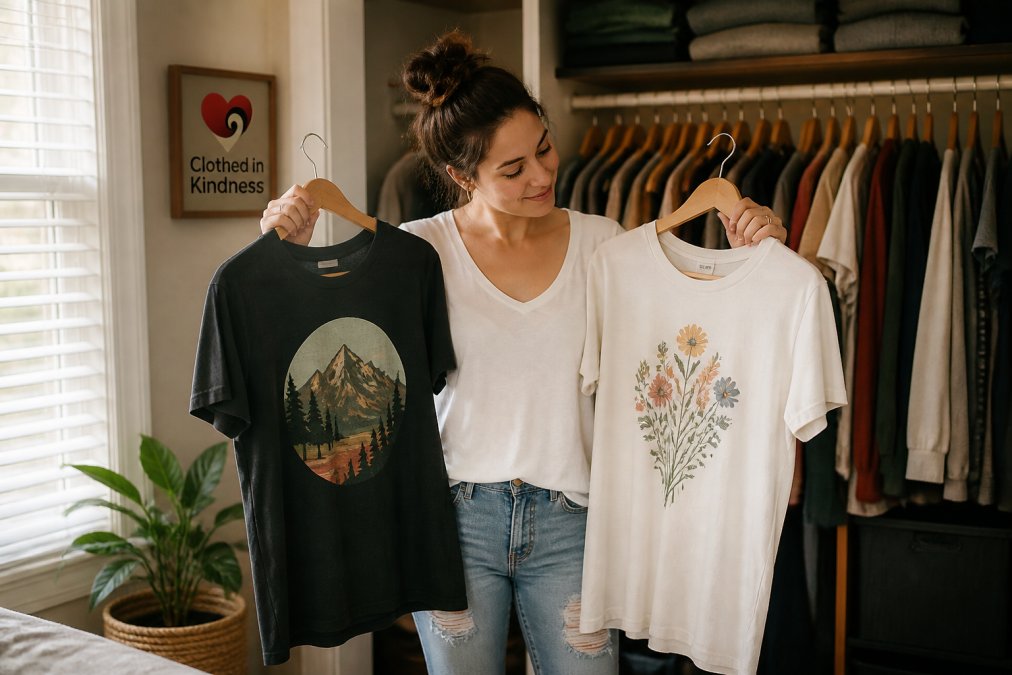
Clothing that expresses personality is the practice of choosing what you wear based on who you are, not just what's trending. It shows up in small decisions: the band tee you keep reaching for, the color you avoid, the jacket that makes you stand a little taller. At Clothed in Kindness Apparel, the whole catalog is built around that idea, because a graphic tee can say something a plain one can't.
The Psychology Behind Getting Dressed
Psychologists who study fashion call this "enclothed cognition," the idea that what you wear affects how you think and behave, not just how others see you (pubmed.ncbi.nlm.nih.gov). A person who feels like themselves in an outfit tends to carry themselves differently. That's why the same shirt can feel like armor on a hard day and a costume on a good one. The garment didn't change.
Why Graphic Apparel Says It Faster
Words on a shirt do the introducing for you. A phrase like "Anti-Social Butterfly" tells people something true before a conversation starts, and it does it with a wink instead of a speech. That's the appeal of expressive graphic tees: they carry a full thought in eight words or fewer.

The Four Fashion Personality Types (and What They Wear)
The four-type framework shows up in almost every style guide, and it survives because it's useful as a starting point, not because it's complete. Most people recognize themselves in one or two of these, and almost nobody fits only one. Treat them as a vocabulary, not a diagnosis.
| Style Type | What They Reach For | What It Communicates | The Trade-Off |
|---|---|---|---|
| Creative | Bold color, graphic prints, layered pieces | "I make things and I'm not hiding it" | Easy to over-buy statement pieces and end up with nothing that works on a Tuesday |
| Classic | Clean lines, neutral tones, tailored cuts | "I value consistency and calm" | Can read as impersonal if nothing in the rotation is actually yours |
| Casual | Soft fabrics, relaxed fits, comfort first | "I'm easygoing and low-maintenance" | Comfort can quietly become invisibility if every piece is a blank |
| Romantic | Texture, warm tones, sentimental details | "I lead with feeling" | Sentimental pieces accumulate faster than wearable ones |
What Each Type Actually Reaches For
The creative type gravitates toward shirts with actual ideas on them, a phrase, a reference, a joke that only some people will catch. The classic type owns the same well-made tee in four colors and considers that a complete wardrobe. The casual type has a uniform and doesn't apologize for it. The romantic type keeps the shirt from a trip ten years ago because it still means something, even if it only gets worn twice a year.
The Part the Four Types Leave Out
The categories describe aesthetics. They don't describe values, and values are where most people's actual style decisions get made. Two people can both be "creative" and end up with completely different closets because one cares about where a garment came from and the other cares about how it fits.
Style Archetypes You'll Recognize
Beyond the four basics, most people also carry a secondary archetype that shows up in specific contexts, the version of you that appears at a concert, at a kid's birthday party, or on a first day at a new job. That context-specific layer is usually where the most interesting pieces live, because it's where personality gets specific instead of general.
A few patterns worth noticing:
- The person whose closet is 80% neutral and 20% loud, and who wears the loud pieces on days that matter to them
- The person who owns one graphic tee per interest and rotates them like a mood ring
- The person who dresses the same on Saturday as on Monday, on purpose, because consistency is the personality
How to Find Your Personal Style Without Overthinking It
Start with three questions, not a mood board.
- What do you reach for when no one is watching?
- What do people compliment you on, and do you believe them?
- What do you avoid wearing, and why?
Most people already know their answers. They just don't trust them yet. A practical next step is wearing one expressive piece a week and noticing how it feels. If a shirt makes you stand up straighter, that's data. If it makes you want to hide, that's data too. Style builds from those small reactions, not from a magazine quiz.
When Your Work Wardrobe and Your Real Personality Disagree
This is the quiet conflict a lot of people live with. The version of you that shows up to a meeting and the version that shows up on a Saturday can feel like two different people, and that gap is real.
Building a Wardrobe That Expresses Personality on a Budget
You don't need forty pieces. You need a few that carry weight.
A workable starter rotation:
- Three graphic tees that each say something different about you
- One hoodie or sweatshirt for cooler days
- One piece that's purely for you, no occasion attached
How Cultural and Generational Influences Shape What You Wear
Nobody picks a style in a vacuum, and most style guides skip past that fact because it's harder to write about than color theory. The decade you grew up in, the region you live in, the music you listened to at seventeen, and the people you spend time with all leave fingerprints on your closet, and those fingerprints don't fade just because you've updated your wardrobe.
Generational Fingerprints
Different generations absorbed different defaults about what clothing is for. Someone who came of age in the 1980s often treats a graphic tee as a statement piece, something you wear when you want to be seen. Someone who came of age in the 2000s often treats it as a baseline layer, closer to underwear than to outerwear. Same garment, opposite assumption about its job.
Cultural and Regional Context
Where you live shapes what counts as expressive. A graphic tee that reads as playful in a casual workplace can read as underdressed in a more formal one, and the same shirt can shift meaning entirely depending on the room. Regional norms matter too, the same design that feels like a conversation starter in one part of the country can feel like a uniform in another, simply because more people around you are wearing something similar.
The Overlap Between Generations and Values
One pattern that cuts across generational lines: people increasingly want their clothing to line up with what they care about, not just with how they want to look. That shows up in different ways depending on the person, some prioritize whether the message on it is one they'd actually stand behind, some prioritize whether the piece will still feel true in five years. The specific priority varies.
Frequently Asked Questions
How do clothes express personality?
Clothes communicate before you speak. Color choices, silhouette, fabric texture, and graphics all send signals about who you are. A person in a relaxed-fit garment-dyed tee with a funny phrase is saying something different than someone in a tailored blazer. The key is that clothing choices reflect individual traits, values, and mood. When what you wear matches your authentic self, people pick up on that consistency, and it becomes a form of non-verbal communication that feels genuine rather than performed.
What are the four fashion personality types?
Most style frameworks group people into four broad fashion personality types: classic, romantic, dramatic, and natural. Classic leans toward clean lines and timeless pieces. Romantic favors soft fabrics and flowing silhouettes. Dramatic goes bold with contrast and statement pieces. Natural prefers relaxed, comfortable, and understated looks. These are starting points, not boxes. Plenty of people blend two or three types depending on the day, the setting, or the season of life they are in.
Can your clothing choices change how you feel?
They can influence your mindset. Many people notice a shift when they put on something that feels like them, whether that is a favorite hoodie with a phrase that makes them laugh or a sweatshirt carrying a message they need to remember. The emotional connection to clothing is real, though it varies by person. The practical takeaway: pay attention to what you reach for on good days and hard days. That pattern tells you more about your style than any quiz.
How do you balance comfort and self-expression in your daily wardrobe?
Start with comfort as the foundation, then layer expression on top. A pre-shrunk cotton-poly blend sweatshirt or a 100% ring-spun cotton tee gives you a soft base, and the graphic does the talking. You do not have to choose between feeling good and saying something. Look for pieces where the fit works for your body and the message works for your personality. Review the sizing information for each garment before ordering, since fits vary by product.
The hard part of personal style isn't finding clothes. It's trusting that the thing you actually like is worth wearing, even when it doesn't match what everyone else has on. Clothed in Kindness Apparel builds around that idea, with graphic tees, sweatshirts, and hoodies that carry humor, faith, nostalgia, and personality in the same catalog. Sizing varies by garment, so check the size guide for the specific piece before ordering. Shop by theme and find the one that sounds like you.