

Encouraging Home Decor for Quiet Spaces
Table of Contents
- Why Encouraging Home Decor Matters in Quiet Spaces
- Lighting and Color: Building a Calming Foundation
- Faith-Based Home Office Decor Ideas
- Calming Home Decor for Stress Relief
- Maximizing Vertical Space and Creating Dedicated Corners
- Budget-Friendly and Neurodivergent-Friendly Design Approaches
- Bringing It Together: Your Quiet Space Checklist
- Frequently Asked Questions
Last Updated: September 18, 2026
Why Encouraging Home Decor Matters in Quiet Spaces
Creating a quiet space isn't just about silence, it's about designing an environment that supports your mental health, reduces stress, and reminds you of what matters, which is exactly what encouraging home decor for quiet spaces accomplishes. Encouraging home decor for quiet spaces transforms these sanctuaries into places that actively lift you up rather than simply exist around you.
The spaces we inhabit shape how we feel. A room filled with clutter, harsh lighting, and visual noise creates mental friction. One designed with intention, with calming colors, thoughtful objects, and gentle reminders of kindness, becomes a refuge. At Clothed in Kindness Apparel, we understand that what we surround ourselves with, like what we wear, communicates something about who we are and who we want to be.
Quiet spaces serve many purposes. They're where you work without distraction, where you recover from stress, where you meditate or journal, where you simply exist without performing for anyone. The decor in these rooms should support all of that. It should whisper encouragement rather than shout for attention.
Lighting and Color: Building a Calming Foundation
The foundation of any serene sanctuary starts with light and color. These two elements shape your emotional response to a room more than anything else. Get them right, and the space feels restful. Get them wrong, and no amount of other decor will fix it.
Warm Bulbs and Dimmers for Ambiance
Lighting determines whether a quiet space feels peaceful or clinical. Warm bulbs, those in the 2700K color temperature range, mimic candlelight and sunset. They activate your parasympathetic nervous system, the part that tells your body to relax. Cool, bright bulbs (4000K and above) do the opposite. They signal alertness and work. For a quiet space, warm is non-negotiable.
Dimmers give you control. A room that's too bright at 10 PM will keep you wired. The same room at half brightness becomes a place where you can actually unwind. Install dimmers on your main light sources and use them. During work hours, you might run at 75 percent brightness. By evening, drop to 40 percent. This simple adjustment signals to your brain that the day is winding down.
The practical benefit is immediate. Many people report falling asleep easier and waking less frequently when they've switched to warm lighting with dimmer control. It's not a placebo, it's how your circadian rhythm actually works.
Color Psychology and Visual Balance
Color affects mood in measurable ways. Soft blues and greens calm the nervous system. Warm neutrals like beige and soft gray create a sense of stability. Saturated reds and oranges energize. For a quiet space, you want the first two categories.
This doesn't mean your room has to be boring. A pale sage green wall behind a desk creates visual interest without overstimulation. Soft gray paired with warm wood tones feels both modern and grounded. The key is saturation, lower saturation colors recede into the background and let your mind rest. High saturation colors demand attention.
Balance matters too. If every wall is the same pale color, the room feels flat. If you paint one wall a deeper shade of your chosen color, you create visual depth without chaos. Pair that with natural wood elements or soft textiles, and the room becomes inviting rather than sterile.
Faith-Based Home Office Decor Ideas
For many people, a quiet space is also a spiritual space. Whether you're starting your day with intention, taking a midday pause for reflection, or winding down with gratitude, the objects around you should support that practice. Faith-based decor doesn't have to be obvious or preachy. It can be subtle, personal, and deeply meaningful.
Incorporating Meaningful Wall Art and Affirmations
Wall art in a quiet space should speak to your values without overwhelming the room. A single framed piece with a word like "Surrender" or "Believe" becomes a focal point. It catches your eye during a difficult moment and reminds you of what you're working toward. The key is choosing art that resonates with your actual beliefs, not art that looks good in magazines.
Affirmations work best when they're specific to your season of life. If you're in a season of letting go, art featuring that message matters more than generic inspiration. If you're building something new, affirmations about growth and courage land differently. The art should feel like it was chosen for you, not mass-produced for everyone.
Placement matters. Hang art at eye level where you naturally look, above your desk, opposite your chair, beside your bed. You want to see it during moments when you need it most. A beautiful piece tucked in a corner you never look at serves no purpose.
Pour Another Cup. Stay Awhile →
Ritual Objects That Anchor Your Space
Objects that support your spiritual practice become anchors. A meditation cushion signals that this is a space for stillness. A journal and pen on your desk invite reflection. A small plant reminds you that life grows. These aren't decorations, they're tools that support how you want to spend time in this room.
Consider adding a mug that holds meaning. The Surrender mug from Clothed in Kindness Apparel comes in 11oz and 15oz sizes and carries a quiet, reflective message. When you hold it during your morning coffee or evening tea, it becomes part of your ritual. The message "Surrender" in soft white type on glossy black ceramic feels like permission to let go of what you can't control. Small objects like this, used daily, shape your mindset more than larger pieces you rarely interact with.

Similarly, the Believe in Yourself mug works as both a functional tool and a daily reminder. At 11oz with a comfortable C-handle, it settles naturally into morning routines. The elegant black script feels sincere rather than saccharine. When you're facing a difficult day, holding something that literally says "believe in yourself" anchors you to that intention.
Calming Home Decor for Stress Relief
Stress relief in a quiet space comes from reducing friction and increasing comfort. This means both what you see and what you feel matter equally.
Textiles and Tactile Comfort
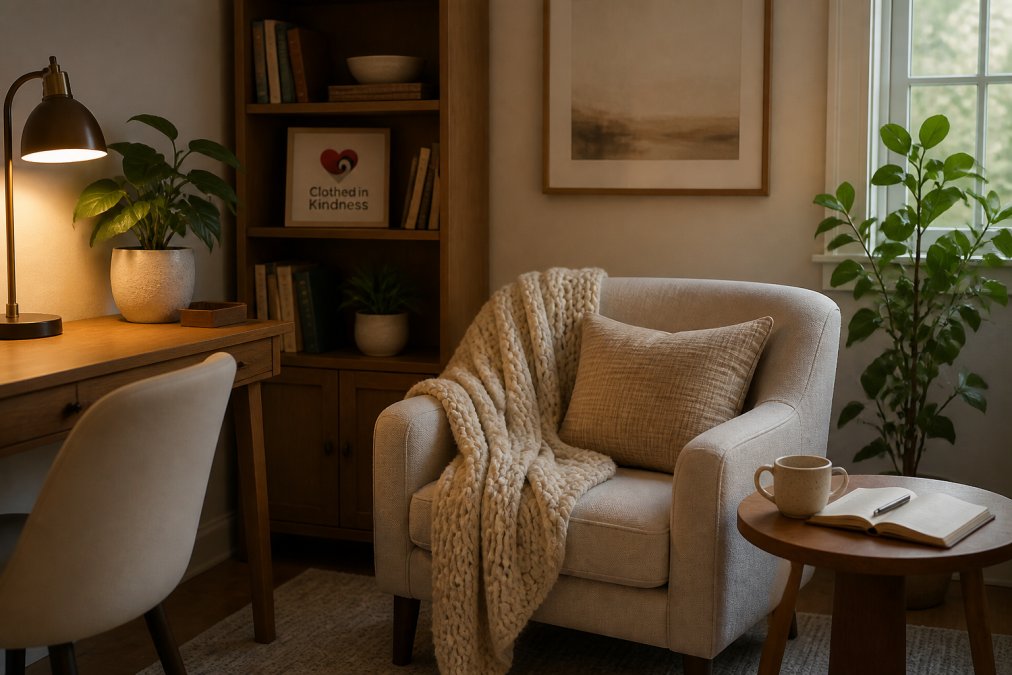
The fabrics in your quiet space should feel good to touch. A rough, cheap blanket signals neglect. A soft, substantial one signals that you're worth comfort. Linen, cotton, and wool all work. The key is weight and quality. A heavy blanket feels more grounding than a thin one. A soft throw draped over your chair becomes something you reach for during tense moments.
Texture variation matters too. If everything is smooth, the room feels cold. Add a woven basket, a chunky knit pillow, a sheepskin rug. Your hands and body register these textures as safe. They slow you down and draw you into the present moment.
The Pour Another Cup. Stay Awhile sweatshirt from Clothed in Kindness Apparel is made with 50% cotton and 50% polyester blended with air-jet spun yarn for a soft feel.
Acoustic Treatment and Sound Management
Sound is the element most guides miss. A visually beautiful quiet space that echoes or picks up every outside noise defeats its purpose. Sound dampening doesn't have to be ugly or expensive.
Maximizing Vertical Space and Creating Dedicated Corners
Small spaces can still be sanctuaries if you use vertical space strategically. Wall-mounted shelves, hanging plants, and tall narrow bookcases all draw the eye upward and create the illusion of more space. They also reduce clutter on surfaces where you actually need to work or rest.
Budget-Friendly and Neurodivergent-Friendly Design Approaches
Not everyone has the budget for a complete redesign. The good news: the most impactful changes cost very little. Warm bulbs and dimmers are inexpensive. Rearranging furniture is free. Adding one meaningful piece of art or one soft textile makes a difference.
Bringing It Together: Your Quiet Space Checklist
Before you start shopping, clarify what you're actually trying to create. A quiet space for work requires different elements than one for meditation or sleep.
| Element | Purpose | Budget Option | Preferred Option |
|---|---|---|---|
| Lighting | Set mood and circadian rhythm | Warm bulbs only | Warm bulbs + dimmer |
| Color | Create visual calm | Paint one accent wall | Paint walls + add art |
| Textiles | Add comfort and texture | One soft blanket | Blanket + rug + pillows |
| Sound | Reduce noise intrusion | Rearrange furniture | Heavy curtains + rugs |
| Ritual objects | Support daily practice | Journal and pen | Mug + journal + plant |
| Wall art | Anchor your values | Printed affirmation | Framed meaningful art |
Frequently Asked Questions
How can I make my quiet space feel more encouraging without cluttering it?
Choose one or two meaningful pieces, a single piece of wall art with an uplifting message, a ceramic mug with an encouraging phrase like 'Believe in Yourself' ($10.56), or a small plant. Pair these with soft lighting and a clean color palette. The key is intentionality: each item should serve a purpose and reflect something that matters to you. Minimalist design and encouraging decor work together when you prioritize quality over quantity.
What are the best colors for a relaxing and peaceful room?
Soft neutrals, warm whites, soft grays, and muted beiges, create a calming foundation. Layer in gentle accent colors like sage green, dusty blue, or warm taupe. Avoid bright, saturated colors that can overstimulate. The goal is visual balance: use the 70/30 rule, keeping 70% of your space in calm, neutral tones and 15% in soft accents, leaving 15% for texture and depth through textiles and natural materials.
How do I incorporate faith-based elements into home office decor ideas without it feeling preachy?
Choose subtle, authentic pieces that reflect your personal faith journey. A small ceramic mug with a meaningful phrase like 'In the End, Only Kindness Matters' ($12.97) on your desk, a single piece of wall art with a quiet affirmation, or a small meditation corner with a journal creates a personal sanctuary. The difference between preachy and sincere is restraint: let one or two items speak for your faith, and let the rest of your space breathe around them.
What role does sound play in creating a quiet, encouraging space?
Acoustic treatment, soft furnishings, textiles, curtains, and wall hangings, absorbs sound and reduces echoes, creating actual quietness. This physical quietness allows your mind to settle, making encouraging elements like affirmations and meaningful decor more impactful. Consider layering soft blankets, adding heavy curtains, or using a small bookshelf as a sound barrier. Sound dampening transforms a visually calm space into a truly restful one.