

Faith Based Home Office Decor Ideas for a Calm Workspace
Table of Contents
- Why Faith Based Home Office Decor Changes How You Work
- Christian Wall Art for Home Office: Verses That Anchor the Room
- DIY Faith-Based Home Decor Projects You Can Finish This Weekend
- Bible Verse Desk Accessories That Keep Encouragement Within Reach
- Creating a Prayer Nook or Meditation Corner in Your Workspace
- Minimalist Christian Office Design: Keeping It Subtle and Genuine
- Frequently Asked Questions
Last Updated: September 14, 2026
Why Faith Based Home Office Decor Changes How You Work
Faith based home office decor ideas work because they turn a generic desk into a place of intention, where objects reinforce who you are.
This guide from CIK Premium Vintage Tees, hoodies, and hats covers how to build that room without turning your office into a chapel, calm, personal, grounded, whether you host video calls all day or write before anyone else is awake.
Faith based home office decor is the practice of choosing artwork, desk objects, and layout details that reflect your spiritual values while still functioning as a professional workspace. It combines interior design decisions with daily encouragement.
The throughline is restraint. Most people over-decorate, then wonder why the room feels cluttered instead of peaceful. The best faith-filled workspaces use fewer pieces, placed with more care.
Christian Wall Art for Home Office: Verses That Anchor the Room
The wall behind your desk does the heaviest lifting: you see it when you look up from a screen, and it appears behind you on camera.
Start with one anchor piece rather than a gallery wall. A single scripture print, metal art verse, or set of wall decals at eye level gives the room a focal point without competing for attention.
Scripture Prints, Metal Art, and Wall Decals
Each format suits a different room; choosing well matters more than choosing many.
| Format | Best For | Watch Out For |
|---|---|---|
| Scripture prints | Rentals, quick swaps | Paper glare on camera |
| Metal art | Long-term anchor walls | Weight and mounting |
| Wall decals | Minimalist setups | Removal on fresh paint |
| Rustic wooden signs | Warm, textured rooms | Bulk in small offices |
A common mistake is buying three pieces at once. Live with one for a week to learn whether it reads as inspiration or noise.
DIY Faith-Based Home Decor Projects You Can Finish This Weekend
Not every piece needs to be purchased. Some of the most meaningful items are the ones you made yourself, and a weekend is enough for two or three.
Here are projects that hold up over time:
- Framed verse cards. Print a bible verse on heavy cardstock, trim it, and place it in a simple frame you already own.
- Painted wooden plaque. Sand a small board, paint a base coat, then hand-letter a short verse or phrase with a fine brush.
- Chalkboard reflection board. Coat a small board with chalkboard paint and write a new verse each week.
- Fabric-covered cork board. Wrap a plain cork board in linen and pin encouraging notes to it.
- Decoupaged pencil cup. Cover a tin can with torn paper and a printed verse, then seal it with a clear finish.
Budget-Friendly Ideas vs. Professional Curation
DIY wins on cost and personal meaning. Professional curation wins on finish, durability, and time saved.
With a free weekend, DIY gives you pieces nobody else owns. If your schedule is full, buy one well-made anchor piece and build around it. Many land in between: one purchased centerpiece, several handmade accents.
Bible Verse Desk Accessories That Keep Encouragement Within Reach
Desk items are where faith based home office decor becomes daily rather than decorative. You touch them constantly, which is why they matter.
A mug is the simplest example: reaching for coffee becomes a small moment of reflection when the message is one you chose on purpose. The All I Need Is Coffee And Jesus mug pairs an everyday ritual with a reminder, and the Faith Over Fear mug does the same at 20oz.


Mugs, Plaques, and Letter Boards for Daily Reflection
Beyond drinkware, three categories cover most desks well:
- Mugs and tumblers for the morning routine, including insulated options for commutes and outdoor work
- Desk plaques for a verse or phrase you want visible but not loud
- Letter boards for verses you change weekly, which keeps the message from going stale
A customizable letter board is the most flexible: rotate a verse, a goal, or a word for the season. The drawback is upkeep, if you never change it, it stops registering.

Creating a Prayer Nook or Meditation Corner in Your Workspace
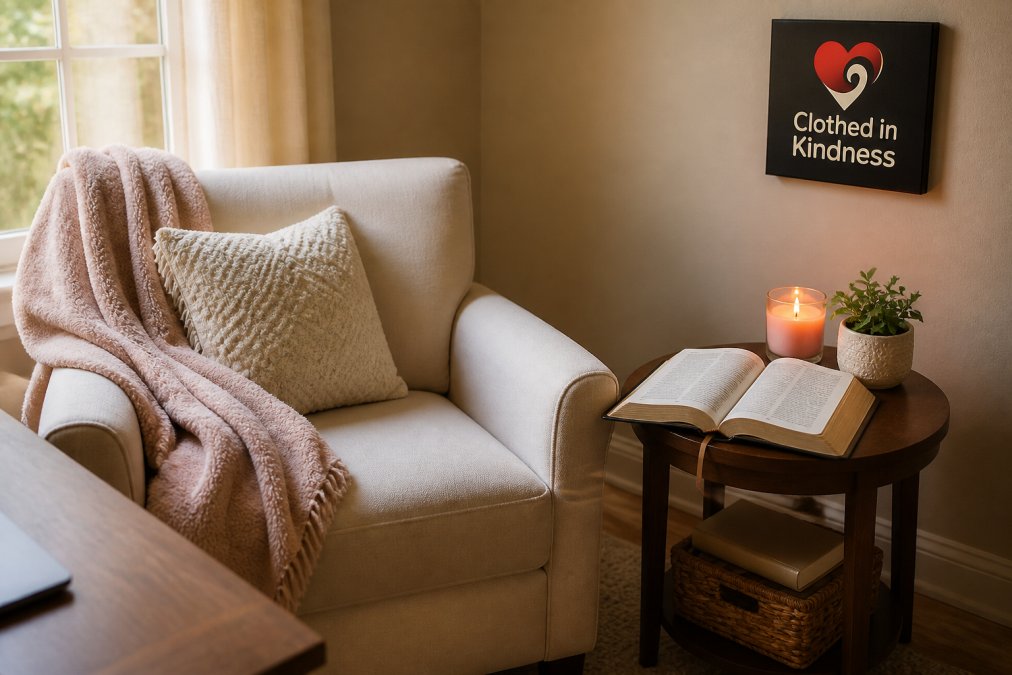
A prayer nook is a small, dedicated area for quiet reflection, typically built around a chair, a side table, and one or two meaningful objects. It does not need its own room, a corner works, and in most homes a corner is the only realistic option.
Start With the Footprint, Not the Decor
Measure the corner before you buy anything. A functional nook needs roughly a 3-foot by 3-foot clear zone for a chair and side table, plus about 18 inches in front of the chair to stand up without shuffling (ADA Standards for Accessible Design Title III Regulation 28 CFR Part 36 (1991)). In a tight office, a 24-inch round stool and a wall-mounted floating shelf fit a 2-foot by 2-foot footprint and still read as intentional.
The most common mistake is buying the chair first, then discovering it blocks a closet door, a floor vent, or your office chair's swing path. Tape the footprint on the floor for two days: if you stop noticing the tape, the spot works; if you keep stepping around it, pick another corner.
Seating: Comfort Beats Aesthetics
A nook you avoid because the chair is uncomfortable is just decoration. Three seating types cover most situations:
- Upholstered armchair. Best for longer prayer or reading sessions. Look for a seat height around 18 inches and a back tall enough to support your shoulders (CUergo: Choosing an ergonomic chair). Trade-off: takes up the most floor space.
- Wingback or accent chair. Adds visual weight and a sense of enclosure, which many people find helps them settle. Trade-off: heavier and harder to move for cleaning.
- Stool or floor cushion. Works in tight rooms and forces a more upright posture. Trade-off: less comfortable past 15 or 20 minutes.
If you already own a chair you love elsewhere in the house, test it in the nook for a week before buying new. Most people find the chair they already gravitate toward is the right one.
Light, Sound, and Scent
Three sensory layers separate a nook from a corner with a chair in it:
- Light. Aim for one warm source you can dim or switch off independently of the room's overhead light. A small table lamp with a 2700K bulb, a battery-operated candle, or a window with a sheer curtain all work. Avoid cool-white bulbs here; they read as task lighting, not rest lighting.
- Sound. A small Bluetooth speaker, a white-noise machine, or simply a closed door does the job. The point is a consistent audio cue that tells your brain this spot is different.
- Scent. A single candle, a diffuser, or a small dish of dried lavender. Keep it to one scent so it becomes associated with the nook rather than with the room generally.
What to Place on the Surface
Resist the urge to fill the side table. Two or three objects is the ceiling:
- An open Bible or a devotional you are currently reading
- One journal and a pen
- A single object with personal meaning, a cross, a stone from a trip, a framed photo
Anything beyond that competes for attention, which defeats the purpose. For a rotating element, use a small letter board or a single framed verse you swap monthly.
The Psychology Angle Most Guides Skip
The reason a nook works is not the decor, it is the cue. A consistent location paired with a consistent sensory signal (same chair, light, scent) trains your nervous system to downshift when you sit there, the same mechanism behind a dedicated meditation cushion. Over a few weeks the nook does part of the work: you sit down, and your breathing slows before you have consciously decided to pray.
That is also why the nook should be visually distinct from your work desk. If the same chair serves both spreadsheets and scripture, the cue is muddied. Even a small separation, different chair, light, or direction you face, preserves the signal.
Positioning Rules That Actually Matter
- Face away from your monitor. Your eyes need somewhere else to rest. Facing a wall with a single piece of art is better than facing a screen.
- Avoid the door sightline if you can. Sitting with your back to an open doorway keeps part of your attention on the room. A wall behind you is calmer.
- Keep it off the video-call background. Your nook does not need to appear on camera. In fact, keeping it out of frame preserves it as a private space rather than a set piece.
A Weekend Setup Checklist
- Clear the corner completely, including anything stored on the floor.
- Tape the footprint and live with it for two days.
- Choose the chair based on comfort, not looks.
- Add one warm, dimmable light source.
- Add one sound cue and one scent cue.
- Place no more than three objects on the surface.
- Sit in it once a day for a week before adding anything else.
If space truly does not allow a nook, a single dedicated chair pulled slightly away from the desk and turned toward a window can serve the same function. The location matters less than the consistency.
Minimalist Christian Office Design: Keeping It Subtle and Genuine
Subtlety is the hardest part to get right, and the most important. A workspace that reads as performative defeats its own purpose, especially on camera.
Minimalist Christian office design means one statement piece, a restrained palette, and clear surfaces. Wood tones, white, and one accent color carry almost any room. Add texture through a throw, a rug, or a wooden plaque rather than more objects.
The Ergonomics-Meets-Spirituality Angle
Most decor guides stop at how a room looks, but a verse you cannot comfortably see is one you will stop noticing. Your desk setup determines whether your faith-based decor actually registers during the workday.
Start with the chair and monitor, then decorate around the corrected sightlines:
- Chair height. Feet flat on the floor, knees roughly level with hips. If your chair has no height adjustment, a footrest closes the gap.
- Monitor distance. About an arm's length from your eyes, with the top of the screen at or slightly below eye level (osha.gov).
- Monitor height. Raise the screen on a stand or a stack of books so you are looking straight ahead, not down.
- Anchor piece placement. With the monitor corrected, the bottom edge of your wall art should sit just above the top of the screen when you are seated. That puts the verse in your natural upward glance rather than behind your head or below the desk line.
A common pattern is hanging art first, then adjusting the chair, and ending up with a verse too high or hidden behind a raised monitor. Fix the ergonomics first; decor placement is downstream.
Why Minimalism Works Better Than Maximalism Here
A workspace with one focal point gives your eye somewhere to rest; five competing focal points create low-grade visual noise most people cannot name but can feel. For a faith-based office, the goal is a room that quiets you down, not one that keeps your attention bouncing.
A practical rule: if you cannot describe the room's focal point in one sentence, you have too many. "The scripture print behind my desk" is a focal point. "The scripture print, the gallery wall, the shelf of figurines, the letter board, and the cross collection" is a room with no focal point at all.
The Restrained Palette in Practice
Three colors, maximum, plus a neutral:
- Base: white, warm off-white, or a soft greige on the walls
- Wood: one tone throughout, mixing light oak with dark walnut in the same small room splits it visually
- Accent: one color, used sparingly, a deep green, a muted navy, or a warm terracotta all work
- Neutral: black or charcoal for frames, lamp bases, and hardware
If you already own pieces outside this palette, do not replace them. Move them to another room or accept them as the one exception. The goal is coherence, not a catalog-perfect room.
What Counts as a Statement Piece
A statement piece is the one object a visitor would describe if asked what the room looks like. It can be:
- A large framed scripture print, roughly 18 by 24 inches or larger
- A metal or wood wall verse
- A single piece of original art with a faith theme
- A well-made cross or wall hanging
What it should not be is a cluster of small items arranged to read as one, that is a gallery wall, usually the wrong move in a small home office.
Camera Considerations
If you spend hours on video calls, the wall behind you is doing public work. Two rules keep it from becoming a distraction:
- Keep the background to one or two elements. A single framed verse and a plant reads as intentional. A busy shelf reads as clutter to everyone on the call.
- Watch for glare. Glass-framed prints directly behind a desk can catch overhead light and blow out on camera. Matte finishes, metal prints, or unframed wood pieces avoid this.
Where Apparel Fits
For readers who want the message to travel with them, apparel does the same work in a different setting. A subtle piece worn to the office carries encouragement without announcing itself, one clear message, no competing graphics.
A Quick Audit
Walk into your office and answer these four questions:
- Can I name the focal point in one sentence?
- Are there more than three colors competing for attention?
- Is the anchor piece visible from my seated, corrected posture?
- Would the background read as calm on a video call?
If any answer is no, fix that one thing before adding anything new. Minimalism is not about owning less, it is about making sure every piece is doing a job.
Frequently Asked Questions
What does the Bible say about decorating your home?
Scripture doesn't give a list of approved decorations, but it does speak to the purpose behind them. Verses like Proverbs 24:3-4 describe a house built and filled through wisdom and knowledge, and Deuteronomy 6:9 encourages writing God's words on doorposts and gates. The principle is intentionality: what you display can serve as a reminder of faith, gratitude, and reflection. For a home office, that might mean a framed bible verse above your desk or a small plaque that grounds your work in purpose rather than just filling wall space.
What Bible verse works well on an office desk?
Short verses that fit on a plaque, letter board, or mug tend to work best. Popular choices include Philippians 4:13 for strength, Proverbs 3:5-6 for trust, and Colossians 3:23 for working with purpose. A desk accessory like the Faith Over Fear mug ($14.50) keeps a verse visible during the workday without taking up much room. The best verse is one that speaks to whatever season you're in, whether that's perseverance, patience, or gratitude.
How can I integrate faith into my workspace without being preachy?
Subtlety works better than volume in shared or professional settings. Choose decor that reads as design first and message second: a minimalist scripture print, a small cross on a shelf, or a mug with a phrase like 'Be A Kinder Human' ($8.22) that carries meaning without announcing itself. The goal is a workspace that feels authentic to you, not one that performs for an audience. Quiet, consistent visual reminders do more for your own focus than bold statements aimed at visitors.
What are some simple DIY faith-based decor ideas for a home office?
You don't need a craft studio to make meaningful pieces. Try framing a printed verse in a thrift-store frame, painting a small wooden plaque with a short scripture, or using a letter board to rotate verses weekly. A chalkboard or corkboard covered in encouraging notes and prayer requests also works well. These projects cost little and let you customize the message to your current season. Pair a DIY piece with one curated item, like a Warm Heart latte mug ($13.66), to balance handmade charm with polish.