

Shirts That Express Your Personality: Graphic Tees
Table of Contents
- Why Clothing Choices Speak Before You Do
- Graphic Tees for Self-Expression: How a Phrase Says What You Mean
- Minimalist vs. Bold: Picking Your Visual Volume
- Color, Fit, and Comfort: What Makes a Shirt Wearable
- How to Build a Personality-Driven Wardrobe That Works
- What Your Shirt Says at Work vs. on the Weekend
- Frequently Asked Questions
Last Updated: October 2, 2026
Why Clothing Choices Speak Before You Do
Long before a conversation starts, a shirt has already said something. Psychologists call this enclothed cognition, the idea that what a person wears shapes both how others read them and how they read themselves. Research from Northwestern University's enclothed cognition studies found that clothing carries symbolic meaning that measurably shifts the wearer's own mindset and confidence.
That is the quiet power behind shirts that express your personality. A graphic tee is a sentence worn on the chest, a small broadcast of humor, belief, or mood that runs all day without a voice.
At Clothed in Kindness Apparel, the whole catalog is built on that idea. The tagline, "Apparel That Sounds Like You," treats a shirt as a form of speech.
Enclothed Cognition: What the Research Suggests
The term enclothed cognition describes how a garment's symbolic meaning influences the person wearing it. Early Northwestern University experiments suggested participants wearing a lab coat described as a doctor's coat performed better on attention tasks than those told it was a painter's coat. Same garment, different story, different result.
Graphic Tees for Self-Expression: How a Phrase Says What You Mean
A graphic tee is a wearable sentence, compressing a personality trait, sense of humor, or belief into a few words and a design. That is why graphic tees for self-expression have become a default for people who dislike small talk but love being understood.
Wit, Sarcasm, and the Slogans People Actually Wear
Sarcastic slogans work when they punch sideways at life rather than down at people. "I Have Standards, They're Mostly Coffee" admits a small, harmless truth about priorities and invites a laugh instead of a debate.
Minimalist vs. Bold: Picking Your Visual Volume
Visual volume is the amount of attention a shirt asks for, and it is a dial, not a switch. A small chest logo and a single line of type sit at the low end. A full-front graphic with large lettering sits at the high end. Neither is better. The right setting depends on where the shirt will be worn and how much the wearer wants to be approached.
| Visual Volume | Design Style | Best For | Wardrobe Fit |
|---|---|---|---|
| Low | Small text, subtle color | Work-adjacent settings, quiet confidence | Layers under jackets and cardigans |
| Medium | Chest print, moderate type size | Everyday wear, errands, casual Fridays | Pairs with denim and neutral bottoms |
| High | Full-front graphic, bright color | Weekends, events, social settings | The outfit's focal point |
Color, Fit, and Comfort: What Makes a Shirt Wearable
Comfort is the gatekeeper. A design that feels meaningful on the hanger becomes a chore if the fabric scratches, the collar twists, or the shoulders pull. An uncomfortable shirt never gets worn often enough to become part of a style identity, it just becomes the one that gets skipped.
Fabric Weight and What It Actually Does
Fabric weight is measured in ounces per square yard, and the number tells you more about how a tee will behave than almost any other spec. Most everyday graphic tees land between roughly 4.2 and 6.5 oz. The low end feels light and cool and drapes close to the body; the high end feels substantial and holds a shape.
Fit Categories, Translated
Fit labels are not standardized across the apparel industry, which is the most confusing thing about buying a tee online. The same word can mean different measurements from one garment to the next. A few working definitions:
- Classic or standard fit sits closer to the body, with a straighter cut through the chest and a hem that lands near the hip.
- Relaxed fit adds room through the chest and shoulders and often drops the shoulder seam slightly, which makes it better for layering.
- Boxy or oversized fit widens the body and shortens the length, changing the whole silhouette and working best when the rest of the outfit is fitted.
Color as a Design Decision
Color does two jobs on a graphic tee: it sets the mood of the garment and decides how much the graphic stands out. A neutral base, whether natural, heather gray, or washed black, turns the print into the focal point and lets the words carry the message. A saturated shirt color flips that: the garment becomes the statement, and the graphic has to work harder to stay readable.
Stay Colorful — Sweatshirt 18000 →
How to Build a Personality-Driven Wardrobe That Works
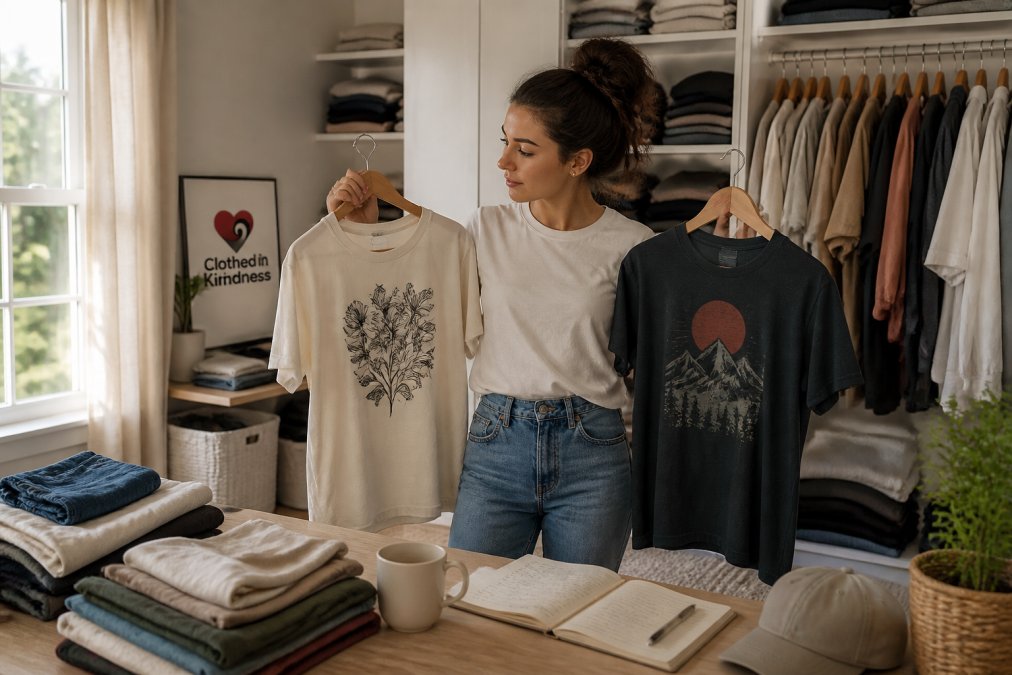
A personality-driven wardrobe is a small set of shirts that each say something different but true, chosen so they mix with the same bottoms and layers. The goal is not volume but coverage: every shirt has a job, and no two are fighting to say the same thing.
A Simple Capsule Starting Point
A workable capsule needs roughly six to eight shirts across a few themes, plus one layer for cooler weather. Here is a starting framework:
- One humor shirt for casual days and social settings
- One faith or values shirt for meaningful moments
- One interest shirt tied to a real hobby or ritual
- One seasonal shirt for fall, Halloween, or a specific time of year
- One neutral or low-volume shirt for quieter settings
- One layer, such as a sweatshirt, for cooler months
- [ ]
What Your Shirt Says at Work vs. on the Weekend
The same personality can be expressed at two different volumes, and the skill is knowing which version a given room can hold. Most style advice skips this part, which is why so many people either hide their personality at work or overshoot and feel self-conscious all day. There is a workable middle, and it comes down to three variables: the message, the layer, and the setting.
Reading the Dress Code Before the Shirt
Workplaces sit on a spectrum, and the shirt has to match where yours actually lands, not where you wish it landed.
- Business formal leaves no room for graphic tees. Skip it.
- Business casual usually means a collared shirt or a clean, unprinted top. A graphic tee is a stretch unless it is worn under a blazer or cardigan and the print stays small.
- Smart casual is the sweet spot. A well-fitting graphic tee under an open layer reads as intentional rather than sloppy.
- Casual or creative is where the dial can go up. Bold graphics, seasonal designs, and playful phrases do their best work where starting a conversation is the point.
The Layer Is the Volume Knob
Layering is the most underused tool for expressing personality at work, because it lets one shirt do two jobs. A bold graphic under an open button-down or a cardigan shows a slice of the design at the chest and hides the rest. The message is present without being loud. If the day shifts, the layer comes off and the shirt is fully visible again.
What to Keep Off the Shirt at Work
The line is not about being boring. It is about not making coworkers do emotional labor. Slogans that punch at a group, reference a controversial topic, or rely on an inside joke nobody else is in on create friction that has nothing to do with the wearer's personality. The same humor that works at a weekend barbecue can read as a test in a meeting room.
The Weekend Is Where the Range Shows
On the weekend, the dial can go up. This is where full-front graphics, seasonal designs like "Resting Witch Face," and playful phrases like "Oh Spicy" or "Never Play Leapfrog with a Unicorn" do their best work. They are built for settings where starting a conversation is the point, and they attract the exact people who share the sense of humor.

Frequently Asked Questions
Does wearing graphic shirts really express personality?
They can. A graphic tee carries a message before you say a word, which is why shirts that express your personality often work better than plain basics for people who want to be read accurately. A coffee joke, a faith-inspired line, or a retro saying all signal something specific. The catch is fit and comfort: if the shirt feels wrong, you will avoid wearing it, and a message nobody sees says nothing.
How do I choose shirts that express my personality without overspending?
Start with three or four themes you actually return to, like humor, faith, coffee, or nostalgia, then buy within those lanes instead of chasing every design you like. Clothed in Kindness organizes its catalog by theme, so you can browse one interest at a time. Because CIK apparel is produced to order and fits vary by garment, check the sizing information on the specific product page before ordering.
Can one shirt show more than one side of who I am?
Yes, and that is often the point. A phrase like "Anti-Social Butterfly" holds two traits at once: warm and expressive, but also someone who protects their energy. Designs built on that kind of tension tend to feel more honest than shirts that pick one trait and shout it. If you are building a personality-driven wardrobe, a few layered designs will do more work than ten one-note ones.
How do I balance personal style with everyday comfort?
Prioritize fabric and fit first, message second. The garment-dyed heavyweight tees in the CIK catalog are 100% ring-spun cotton with a relaxed fit, while the crewneck sweatshirts are a 50/50 cotton-polyester blend with a classic fit, so the two feel different on purpose. Read the size guide for the exact item you want, since measurements differ between the tee and sweatshirt styles.