

Graphic Tees for Self Expression: Wear What Says You
Table of Contents
- Why Graphic Tees for Self Expression Beat Small Talk
- The Psychology Behind Wearing Your Personality
- How to Style Graphic Tees So They Look Intentional
- Fabric Quality and Printing Longevity: What Actually Lasts
- Fabric Quality and Printing Longevity: What Actually Lasts
- Graphic Tees for Different Life Stages and Seasons
- Building a Capsule Wardrobe Around Statement Apparel
- Building a Capsule Wardrobe Around Statement Apparel
- Conclusion
- Frequently Asked Questions
Last Updated: September 27, 2026
Why Graphic Tees for Self Expression Beat Small Talk
A graphic tee does the introducing before anyone asks a question. That is the quiet advantage of graphic tees for self expression: the shirt speaks first, and the wearer decides how much to add.
The Psychology Behind Wearing Your Personality
Identity-based dressing means choosing clothes that align with how a person sees themselves rather than how a trend or dress code says they should look. It turns getting dressed into a small daily act of self-definition.
How to Style Graphic Tees So They Look Intentional
Styling a graphic tee well comes down to one principle: treat the shirt as the focal point and keep everything around it quiet. Statement apparel reads as intentional when the rest of the outfit supports it instead of competing with it.
Start With the Fit, Not the Outfit
A graphic tee reads as deliberate or as an afterthought mostly because of how it sits on the shoulders and through the torso. Two measurements do most of the work:
- Shoulder seam placement. On a standard fit, the seam should land at or just past the edge of the shoulder bone. A seam that sits well inside the shoulder pulls the chest tight and distorts the graphic; a seam that drops several inches past the shoulder reads as intentionally oversized, which is a different look and needs different bottoms.
- Torso length. A tee that ends at the hip bone looks tidy and works tucked or untucked. A tee that ends mid-fly is built for tucking or for a longer layer over it. A tee that ends above the belt line is a crop, whether or not anyone calls it one.
Layering Without Losing the Message
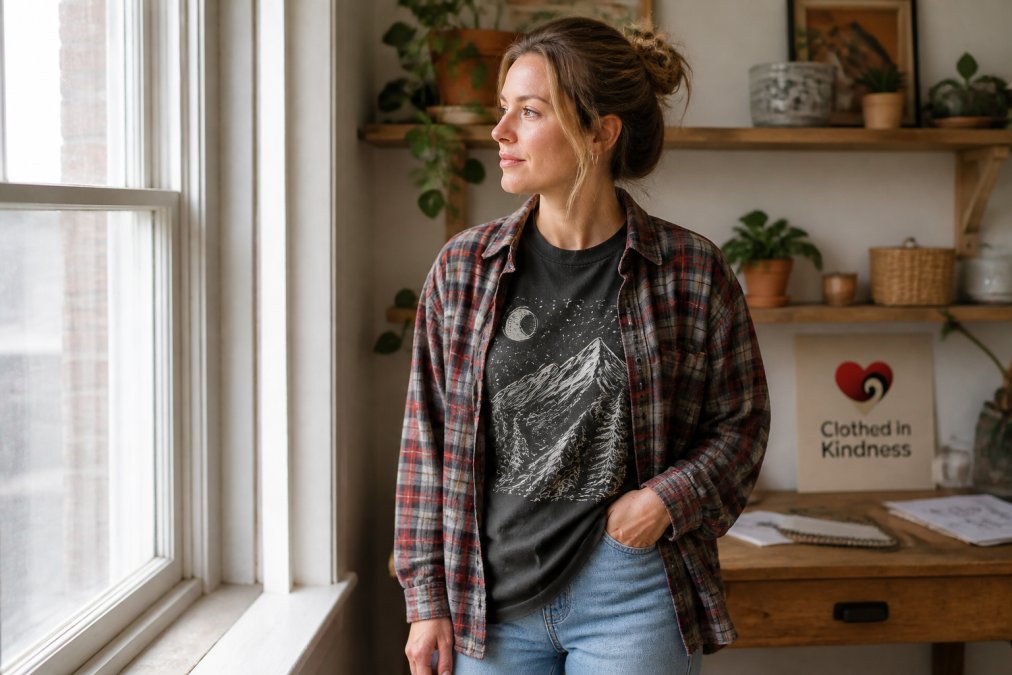
An open flannel, denim jacket, or unbuttoned overshirt frames the graphic without covering it. The key is to leave the chest area visible. A cardigan buttoned to the collar hides the whole point.
A few layering mechanics worth knowing:
- Open overshirt, graphic centered. Works with almost any graphic size. The overshirt's vertical lines frame the design.
- Half-buttoned flannel. Button the bottom two buttons only. The graphic stays visible, the flannel still reads as a layer rather than a shirt.
- Crewneck over a tee. Only works if the graphic sits low enough to peek out at the hem. Otherwise pick one or the other.
- Jacket over a tee, graphic partially covered. Fine, but the visible fragment should still make sense on its own. A design that only reads as a full phrase will look like a mistake when half of it is under a collar.
Tucking, Knotting, and Other Small Moves
A front tuck changes the silhouette more than most people expect. It defines the waist, breaks up the boxiness of a relaxed fit, and makes the outfit look considered rather than thrown on.
- Full tuck with a belt for a cleaner, more structured look
- Front tuck for a relaxed middle ground that works with almost any bottom
- Side knot for a cropped effect without altering the shirt
- Untucked and oversized styled with slim bottoms to balance the volume
Matching the Shirt to the Occasion
The same graphic tee can read as weekend-casual or as underdressed depending on what surrounds it. A rough guide:
| Occasion | What makes it work | What breaks it |
|---|---|---|
| Errands, casual hangouts | Tee as-is, any bottom | Nothing, really |
| Dinner, casual workplace | Tee under a structured layer, tucked, with clean shoes | Graphic competing with a loud bottom |
| Concert, festival, night out | Tee as focal point, darker bottoms, one accessory | Too many competing graphics or logos |
| Family photos, events | Tee in a solid or muted colorway, coordinated with others | A graphic that fights the group's palette |
One Accessory Rule
Graphic tees already carry a message. Adding a second one, a logo hat, a slogan tote, a printed jacket, splits the reader's attention and the outfit stops reading as intentional. Pick the tee as the statement and let everything else be quiet.
Fabric Quality and Printing Longevity: What Actually Lasts
Fabric Quality and Printing Longevity: What Actually Lasts
Fabric weight and print method determine how long a graphic tee survives regular wear. Two shirts can look identical on a screen and behave completely differently after twenty washes.
Here is what actually extends a print's life:
- Wash inside out on cold
- Skip the dryer or use low heat
- Avoid fabric softener, which leaves residue on the print
- Hang dry when possible
- Never iron directly over the graphic
Graphic Tees for Different Life Stages and Seasons
The same person needs different messages at different times, and a good rotation reflects that. A shirt that fits a season of confidence may feel wrong during a season of recovery. That is not inconsistency. It is honesty.
Anti- Social Butterfly — Tee CC 1717 →
Why the Message Changes With the Season
A few patterns show up often enough to be worth naming:
- New chapter energy. A move, a new job, a graduation, a fresh start. The shirt tends to be forward-facing, a phrase about becoming, starting, or showing up.
- Holding pattern. A season of waiting, recovery, or uncertainty. The shirt tends to be quieter and more inward, a reminder rather than an announcement.
- Confidence season. When things are clicking, the shirt can be louder, funnier, or more visually bold. This is when a person is most likely to wear something that invites a comment.
- Nostalgia season. Reconnecting with an earlier version of yourself, a decade, a hobby, a place. Retro sayings and vintage-feel designs do a lot of work here.
Faith, Humor, and the Rest of a Whole Person
One of the more limiting assumptions about graphic tees is that a person has one theme. In practice, the same wardrobe often holds a faith-forward design, a sarcastic one, a coffee-lifestyle piece, a fitness shirt, and something seasonal, and all of them are accurate.
Seasonal Rotation Without Overbuying
A practical way to handle the shifting-message problem without accumulating a drawer of unworn shirts:
- Pick two anchor themes that describe the current season of life. Buy those first.
- Add one contrast piece, something from a different theme that still feels true. This is what keeps the rotation from becoming a uniform.
- Add one seasonal piece when the season actually arrives, not in advance. Fall and Halloween designs, for example, get worn hardest in a narrow window.
- Retire, don't discard. A shirt from a past season can come back later. The message that felt wrong six months ago may fit again.
When the Message Is for Someone Else
Graphic tees also work as a way to say something to another person without a speech. A shirt worn to a family gathering, a first day at a new school, or a hard week can carry a message the wearer would not say out loud. That is why the same design can mean something different to the wearer than to the reader, and why the best graphic tees work on both levels at once.
Building a Capsule Wardrobe Around Statement Apparel
Building a Capsule Wardrobe Around Statement Apparel
A capsule approach to apparel curation means owning fewer pieces that all work together, with graphic tees doing the personality work and basics doing the structural work. The goal is a closet where everything gets worn.
A workable starting point looks like this:
| Layer | Quantity | Role in the Outfit |
|---|---|---|
| Graphic tees | 5-7 | The focal point and personality |
| Neutral tees | 3-4 | Base layer under jackets and overshirts |
| Overshirts or flannels | 2-3 | Framing without covering the graphic |
| Sweatshirt or hoodie | 1-2 | Cold-weather layering |
| Bottoms in 2-3 neutral tones | 4-5 | Everything pairs with everything |
| Hat or cap | 1-2 | Finishes the look, extends the theme |
Conclusion
The hard part of self-expression through clothing is not finding a shirt with words on it. It is finding pieces that still feel true six months later, after the novelty wears off and the shirt becomes part of the regular rotation.
Frequently Asked Questions
Are graphic tees out of style in 2026?
Not at all. Graphic tees remain one of the most flexible pieces in casual style, and the current focus is on intentional design rather than loud logos. Statement apparel with meaningful phrases, retro references, or original art fits right into modern streetwear and everyday outfits. The key is choosing graphics that feel personal to you, then styling them with layers, good fits, and wardrobe staples so the whole look reads as deliberate rather than thrown together.
How do you style graphic tees to look intentional?
Start with fit. A relaxed or unisex cut works well tucked into high-waisted pants or left loose over straight-leg denim. Layer under an open button-down, denim jacket, or cardigan to frame the graphic instead of hiding it. Keep the rest of the outfit simple so the tee carries the message. Rolling sleeves, adding a hat, or knotting the hem at the waist are small moves that make the whole look feel styled rather than accidental.
What makes a graphic tee feel personal rather than generic?
Specificity. A phrase that captures your humor, a reference only your people would recognize, or a design tied to a season you are actually in lands differently than a mass-produced slogan. Look for tees that reflect something true about you, whether that is an introvert's honesty, a faith reminder, or a nostalgic inside joke. When the message matches your real personality, people notice, and the shirt stops feeling like a costume.
Can your wardrobe change with your seasons of life?
Yes, and graphic tees are one of the easiest ways to mark that shift. A tee that said one thing in your twenties can give way to something that fits a new role, a new mindset, or a harder season. Building a small rotation of pieces that reflect where you are now keeps getting dressed simple and keeps your closet honest. You do not need a full overhaul, just a few tees that sound like the current version of you.